Three Doctors, Two Generations, One Legacy: How the Rice Family Brought Modern Medicine to Stevens Point, Wisconsin
From horse-drawn cutters to modern surgical suites, the story of the Rice family is the story of healthcare itself in Central Wisconsin.

In the quiet winters of the early 1920s, a horse-drawn cutter could often be seen gliding through the snowy streets of Stevens Point and out into the rural darkness of Portage County. Huddled under heavy blankets against the biting wind were two figures: a weary physician and his teenage son. For the father, it was another house call in a career defined by rural medicine. For the son, it was an apprenticeship in a calling that would consume his life. Between them sat a charcoal heater, fighting a losing battle against the Wisconsin frost.
This scene was the bridge between two eras. The father was Dr. Daniel S. Rice, a pioneer physician. The son at the reins was the future Dr. Maurice Rice. Along with the eldest brother, Dr. Rhody Rice, these three men formed a medical dynasty that would span nearly a century. They did not merely practice medicine in Stevens Point; they transformed it, evolving from general practitioners delivering babies by lantern light to the founders of a modern multi-specialty clinic that changed the region’s landscape forever.
The Pioneer: Dr. Daniel S. Rice (1863-1937)
The story begins with Daniel S. Rice, born June 4, 1863, in Morrison, Brown County. The son of pioneer parents John and Mary Rice, Daniel’s path to medicine was not direct. He first dedicated himself to education, attending St. Francis’ seminary near Milwaukee and later studying in Valparaiso, Indiana. For six years, he served as the Brown County Superintendent of Schools, shaping the minds of the youth before deciding to heal their bodies.
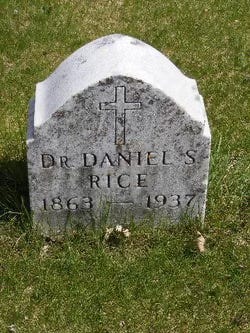
At the turn of the century, medicine was rapidly professionalizing, and Daniel joined this new wave. He graduated from the College of Physicians and Surgeons in Chicago on April 20, 1897. After a brief two-year practice in Custer, he moved his practice to Stevens Point in 1899, establishing an office in the Kuhl building on Main Street—a structure known to later generations as Hunter’s Corner.
In 1900, he married Elizabeth Heffron, cementing his roots in the community. Dr. Daniel Rice became a pillar of Stevens Point society, serving on the staff of St. Michael’s Hospital and holding memberships in both the Portage County and Wisconsin State Medical Societies. A man of deep faith and civic duty, he organized the Knights of Columbus Council No. 1170, serving as its first Grand Knight. For over three decades, he was the quintessential country doctor, serving his neighbors until a stroke in November 1932 forced his retirement. He passed away on May 26, 1937, at the age of 73, leaving behind a legacy that his sons were just beginning to build upon.
The Eldest Son: Dr. Rhody Rice
The mantle of the family practice first fell to the eldest son, Dr. Rhody Rice. Following in his father’s footsteps, Rhody became a general practitioner and joined Daniel in the Stevens Point office. For a time, it seemed the practice would continue simply as a father-son endeavor, maintaining the traditions of general family medicine.
However, tragedy altered the trajectory of Rhody’s career. He contracted tuberculosis, a diagnosis that was often a slow sentence in the pre-antibiotic era. Recognizing his failing health and the needs of his patients, Rhody made a request that would inadvertently plant the seeds of the future clinic: he asked the State Medical Society to send help. They sent Dr. Robert Slater.
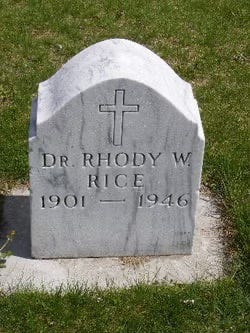
Soon, the phone at the practice was answered, “Dr. Rice and Slater’s office.” As Rhody’s health declined, Dr. Slater handled the bulk of the patient load. Dr. Rhody Rice died in 1946, just one month after his younger brother Maurice returned from World War II. His life, though cut short, served as the critical link between the solo practice of his father and the collaborative future his brother would forge.
The Surgeon: Dr. Maurice G. Rice (1907-1991)
While Rhody was the heir apparent, the younger brother, Maurice, born on January 1, 1907, was the revolutionary. His medical education began long before medical school, on those freezing cutter rides in the 1920s.
“When I was in high school, I had to drive him all around the place in a cutter with a team of horses. We still have the charcoal heater that used to keep his feet warm during those rides.”
Those early experiences left an indelible mark, though not always a positive one regarding obstetrics. Most of those late-night dashes were to deliver babies. “I was never very strong on the baby business...even when I became a doctor,” Maurice later recalled.
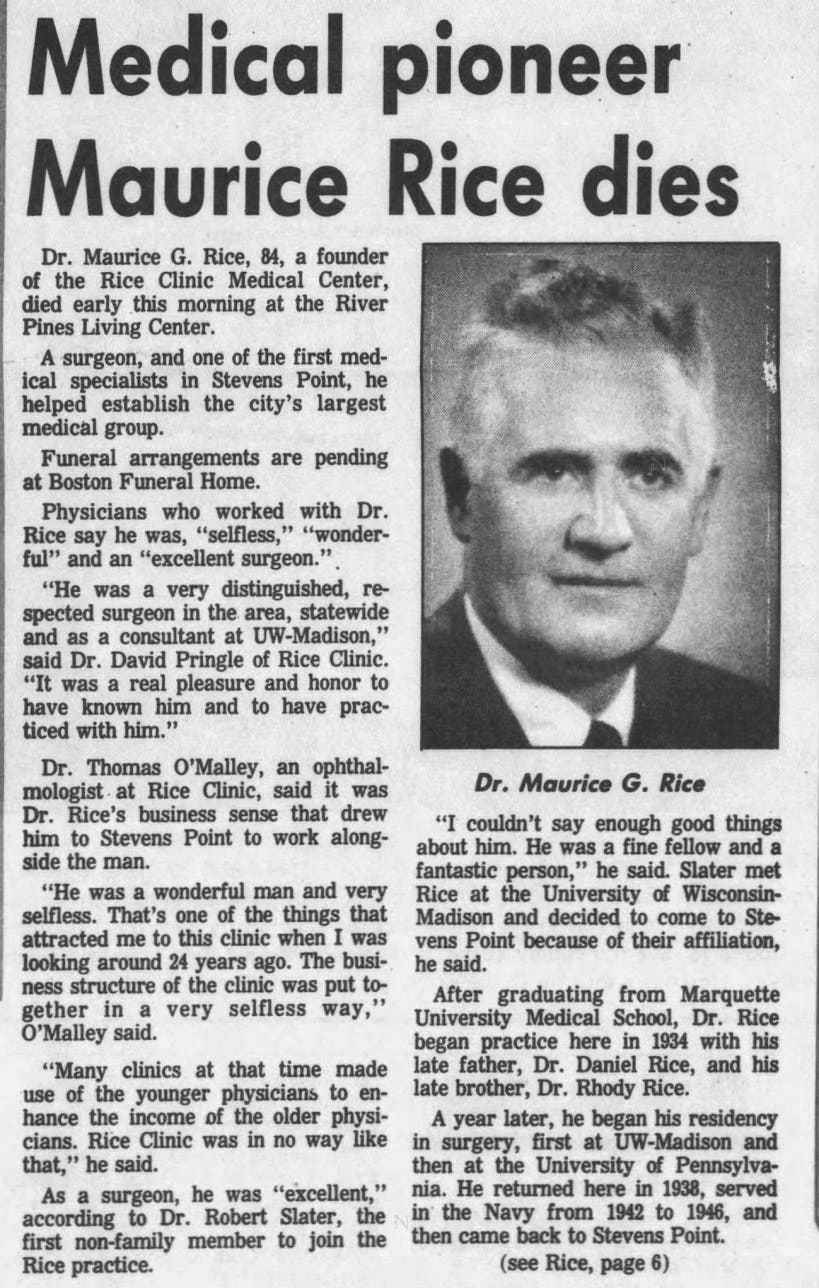
Despite his reservations about midnight deliveries, Maurice graduated from Marquette University Medical School and completed his internship at Milwaukee County Hospital, where the chaos of emergency medicine was a daily reality—he once delivered one baby in an ambulance and another in a cab. Around 1933-1934, he returned home to join his father and brother.
“Then I practiced for about two years with Rhody and father, who hadn’t been well because of a stroke. I was low man on the totem pole. They’d send me out on the house calls, delivering babies in the middle of the night at some old shack in the country.”
It was his father and Rhody who recognized that medicine was changing. They decided Maurice should not just be another general practitioner but should specialize. With their encouragement, he pursued surgery, eventually becoming board certified surgeon #490 in the nation—a pioneer among only 32,488 certified surgeons at the time. He earned a Master’s of Surgery degree from the University of Pennsylvania and conducted research at UW-Madison.
His career was interrupted by duty; Maurice enlisted in the Navy in 1942, serving in the Pacific theater until 1946. When he returned to Stevens Point, he was the first board-certified general surgeon in the community. But the homecoming was bittersweet; his brother Rhody passed away only a month later.
Building the Rice Clinic: “I Brought Other Guys Here”
Dr. Maurice Rice’s most enduring contribution to Stevens Point was not a specific surgery, but a philosophy. He realized that the era of the solitary doctor was ending. To provide the best care, he needed a team. As he often said, his greatest achievement was simple: “I brought other guys here.”
Maurice began by modernizing the operating room, teaching nurses to organize instruments logically rather than piling them in trays. He fought against the ethical murkiness of fee-splitting arrangements, insisting on professional integrity. But mostly, he recruited.
He formally partnered with Dr. Robert Slater, who had sustained the practice during the war, and Dr. Fritz Reichardt, an orthopedic surgeon. The practice’s identity evolved with its roster. The telephone greeting shifted from “Dr. Rice and Slater’s office” to “Dr. Rice, Slater and Gehin’s office,” until finally, it became simply the “Rice Clinic.”
The team grew to include Dr. Robert Bickford, an internal medicine specialist from Texas, and others like Drs. Eckberg, Hacker, Bosworth, and O’Malley. To house this growing medical powerhouse, the Rice Clinic building was completed between 1951 and 1952 at 2501 Main Street. In 1953, a building corporation was formed.
The move was controversial among the older residents of the city. Accustomed to the downtown office, they complained about the new location: “Way out there on the east side,” they grumbled. “The bus doesn’t even run out there!” But Maurice knew that for the clinic to grow, it needed space that the old Kuhl building couldn’t provide.
The Teacher and the Legacy
Dr. Maurice Rice was a practitioner, but he remained a student and teacher at heart. For ten years, he served as an Associate Professor at UW-Madison. Every Tuesday, regardless of the weather, he drove to Madison to teach a surgery class before driving back to Stevens Point. His academic curiosity led him to conduct neurosurgery research with Dr. Irwin Schmidt in the 1950s and participate in a teaching exchange in Edinburgh, Scotland.
Colleagues remembered him as an “excellent surgeon” and, perhaps more importantly, as “selfless.” This quality was woven into the very fabric of the Rice Clinic. Unlike many practices of the time that used younger associates to generate profit for senior partners, Maurice structured the clinic “in a very selfless way,” ensuring fairness for the physicians he recruited.
Dr. Maurice Rice retired from active practice in 1971 due to health reasons, eventually working for the Social Security Administration in Madison before returning to Stevens Point in 1980. He passed away on September 9, 1991, at the age of 84.
A Family That Healed a Community
The story of the Rice doctors—Daniel, Rhody, and Maurice—is the story of American medicine writ small. In the span of two generations, from 1899 to 1971, they bridged the gap between the charcoal-heated cutter and the modern surgical suite. They transformed Stevens Point from a town served by general practitioners into a regional hub for specialized medical care.
Maurice’s grandson, Greg Rice, is currently a medical doctor in LaCrosse, WI.
The Rice Clinic, which became the city’s largest medical group, stands as their monument. But their true legacy lies in the thousands of lives touched by their hands—the babies delivered in shacks by lantern light, the surgeries performed with newfound precision, and the specialists brought to a small Wisconsin town because one family believed their community deserved the very best.
SOURCES
This article draws upon historical records from the Stevens Point Daily Journal(archives from 1937, 1987, and 1991) and genealogical records preserved by the Stevens Point Area Genealogy Society.