
The old depot clock at Stevens Point’s Soo Line station read just past midnight when a handful of people gathered in the pre-dawn darkness of Saturday, January 16, 1965. They weren’t there to board a train or greet arriving passengers. They were there to witness an ending—the final passage of passenger train service through a city that had been defined by the railroad for nearly 94 years.
The Laker Makes Its Last Run
Train No. 4, known as “The Laker,” arrived at Stevens Point’s depot in the early morning hours, having departed Chicago’s lakefront station the previous evening on its final overnight journey to Duluth-Superior. The train that had once connected the industrial heart of Chicago with the iron ore ports of Lake Superior was making its last call at the dozen Wisconsin stations that had relied on it for years.
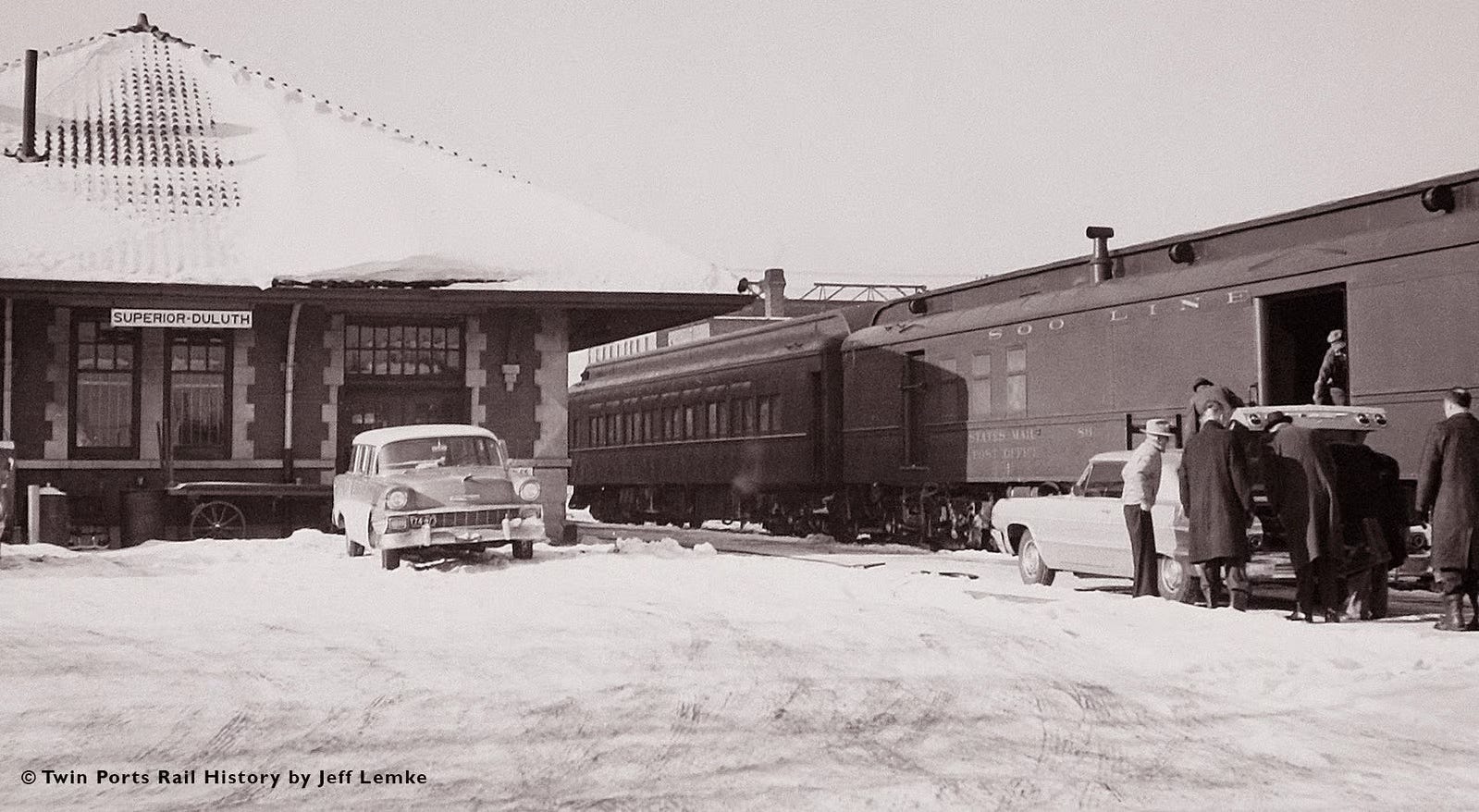
(Last Soo Line Laker No. 4 at Superior, January 15, 1965 - This is a photograph of The Laker on its final run, arriving at Superior, Wisconsin on January 15, 1965. This is the actual last day of service! Source: Flickr - Jeff Lemke Collection)
By January 1965, The Laker was a shadow of what passenger trains had once been. Gone were the elegant dining cars and multiple sleepers that had graced the route in earlier decades. The final consist included just a locomotive, a mail car, a baggage car, and a handful of aging heavyweight coaches—solid, functional equipment from another era, still doing its job but looking increasingly out of place in the jet age.
The train’s arrival at Stevens Point was quiet, almost perfunctory. A few passengers alighted, a few boarded. Mail was exchanged. Then, within minutes, The Laker moved on into the winter darkness, continuing its journey northward through Wisconsin toward its terminus in Duluth-Superior.
It would be the last time a passenger train stopped at Stevens Point. The Soo Line engineer on this last run (1/15/65) of The Laker was Oliver A. Anderson of Stevens Point. Also in the cab of the locomotive was Joel O. Anderson (age 10). Other passengers riding coach were Christine R. Anderson (age 14), Doreen K. Anderson (age 8) and William J. Anderson (age 6). The four younger Andersons rode only as far as Junction City, where they were meet by their mother Gertrude A. Anderson.
The Economics of Extinction
The Laker’s discontinuation on January 15, 1965, was the culmination of years of mounting financial losses. By the train’s final run, Soo Line officials calculated that The Laker alone was losing approximately $500,000 annually—a staggering sum equivalent to about $5 million today. In its last years of operation, the train was carrying a mere handful of passengers per trip, unable to compete with the automobile and the airplane that had transformed American travel.
The Interstate Commerce Commission had approved the discontinuation after years of Soo Line petitions. It was part of a national pattern: by 1966, less than 2 percent of all intercity passengers in America would be traveling by rail. The golden age of rail passenger service—when trains like the Wisconsin Central’s original passenger trains had revolutionized Stevens Point in 1871—had definitively ended.
From Wisconsin Central to Soo Line: The Corporate Evolution
The passenger service that ended in January 1965 had its roots in that first train that arrived in Stevens Point in November 1871 under the banner of the Wisconsin Central Railroad. The depot where The Laker made its final stop had been built in 1917-1918, replacing an earlier structure that had been destroyed by fire.
That fire, which occurred in January 1917, nearly cost Stevens Point much more than just a depot. The city faced the very real possibility of losing its status as a railroad division headquarters—and the hundreds of jobs that came with it. Only a swift civic campaign, which raised funds to purchase additional land around the old depot site so a much larger facility could be built, saved the day.
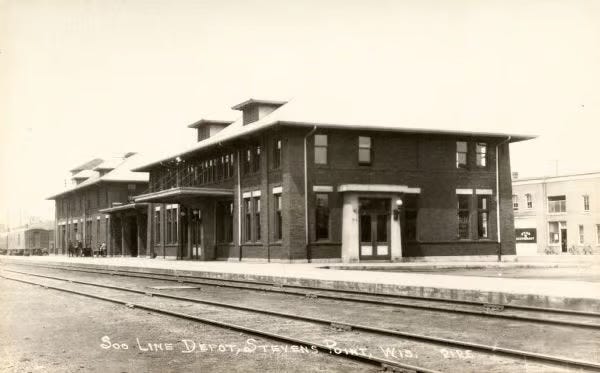
The new depot complex, designed by architect Christian Madsen in the Prairie School style, was constructed by his Withee Construction Company at a cost estimated between $53,000 and $70,000. The elegant two-story brick building, with its wide overhanging eaves, horizontal bands of windows, and earth-toned colors, opened on June 19, 1918. It was the third depot to stand on approximately the same site, and it represented Stevens Point’s importance as a railroad center.
By 1918, the Wisconsin Central Railway had long been leased by the Soo Line (officially the Minneapolis, St. Paul and Sault Ste. Marie Railroad), which had taken over operations in 1909. In 1961, the Wisconsin Central Railway, Duluth South Shore & Atlantic, and the MStP&SSM formally merged to create the Soo Line Railroad Company.
Through all these corporate changes, passenger trains had continued to serve Stevens Point. At the service’s peak, as many as six railroad hotels—with names like the Majestic and the European—had dotted the city to serve travelers. The railroad had transformed Stevens Point from a small lumber town of 2,000 people to a thriving industrial center with twenty sawmills within five years of that first train’s arrival in 1871.
The Automobile Revolution
What killed passenger train service wasn’t just about dollars and cents—it was about America’s love affair with the automobile and the construction of the Interstate Highway System. After World War II, automobile ownership exploded across the United States. Families who once planned their travels around train schedules now had the freedom to leave whenever they wanted, drive directly to their destinations, and explore at their own pace.
The Federal Interstate Highway System, launched under President Eisenhower in 1956, accelerated the shift. By 1965, new highways were cutting travel times between cities, making driving more convenient than ever. Why wait for a train on the railroad’s schedule when you could drive on your own?
Airlines, too, were stealing passengers. Jets were making long-distance travel faster than trains could ever match. A trip from Chicago to Duluth that took The Laker fourteen hours overnight could be flown in a fraction of the time.
Small carriers like the Soo Line, serving rural routes through places like Stevens Point, were hit especially hard. The financial hemorrhaging became unsustainable.
What Came After
When The Laker made its final departure from Stevens Point in the pre-dawn hours of January 16, 1965, it marked the end of an era, but not the end of the depot itself. The substantial brick building that had risen from the ashes of the 1917 fire continued to serve railroad purposes for years afterward. Today, the building still stands at 1625 Depot Street, housing Canadian National Railway’s United States customer service center—a reminder of Stevens Point’s enduring connection to rail transportation, even if passengers no longer board trains there.
Freight service continued—and continues today—through Stevens Point. The Canadian National Railway, which eventually acquired the former Wisconsin Central and Soo Line trackage, still moves goods through the city. The rails remain busy, but the whistles that once announced arriving passengers now herald only the passage of freight cars.
Six years after The Laker’s final run, Congress would create Amtrak in 1971 to preserve intercity passenger rail service across America. But Amtrak’s route system bypassed Stevens Point, as it bypassed hundreds of smaller cities that had once been served by passenger trains. The national rail passenger network that Amtrak inherited was already a skeleton of what it had been—and Stevens Point wasn’t on the remaining bones.
A Building That Survived
The 1917-1918 depot stands as a testament to multiple eras of Stevens Point history. It survived where two earlier depots had not. It witnessed the peak years of passenger rail service in the 1920s through 1940s. It saw the slow decline of the 1950s. And it was there when The Laker made that final stop in the darkness of a January morning in 1965.
The depot’s Prairie School architecture—with its characteristic horizontal emphasis, wide eaves, and functional elegance—was already becoming historic by 1965, representing the optimistic early decades of the 20th century when railroads were building for growth, not managing decline. Designed by Christian Madsen and built at considerable expense in a time of civic crisis, the depot was meant to anchor Stevens Point’s railroad future for generations.
It did serve for nearly half a century of passenger operations. And it continues to serve the railroad industry today, though in a vastly different capacity than its builders imagined.
Echoes of the Rails
Today, the story of Stevens Point’s last passenger train is part of a larger American narrative of transformation. The same pattern played out in communities across the country: the arrival of the railroad in the 19th century brought prosperity and growth; the departure of passenger service in the mid-20th century marked a shift to new forms of transportation and new ways of connecting communities.
The depot still stands—solid, dignified, a testament to an era when the arrival of a train was an event, when the platform was a place of reunions and farewells, when the railroad wasn’t just infrastructure but the very heartbeat of community life.
On that dark January morning in 1965, as The Laker’s taillight disappeared into the pre-dawn Wisconsin winter, it carried with it not just the last passengers but the end of an entire era of Stevens Point history. The rails remain. The depot endures—a survivor of fire, economic change, and the transformation of American transportation. But the passengers—they took to the highways instead, and never looked back.
Sources:
Stevens Point Journal, January 16, 1965
WXPR: “The First and Last Soo Line Passenger Trains” by Gary Entz, April 17, 2019
Trains Magazine: “Soo Line passenger trains remembered,” June 2023
Wikipedia: Minneapolis, St. Paul and Sault Ste. Marie Railroad
Wisconsin Historical Society: Property Record for 1625 Depot Street, HI70969
Portage County Gazette: “Depot an example of fine architecture” by Wendell Nelson, January 3, 2003
Nelson, Wendell. “The Dream of Years: A History of the Wisconsin Central/Soo Line/Canadian National Depots in Stevens Point, Wisconsin.” Bancroft, WI, 2009.
American-Rails.com: “Rail Travel’s Decline (USA): 1950s-1970s”
Zenith City Online: “During this week in Duluth in 1965” (Facebook historical post documenting $500,000 annual losses)
Note on Dates: Multiple authoritative sources confirm the final run of The Laker occurred on January 15-16, 1965, with the westbound train departing Chicago on the evening of January 15 and arriving at various Wisconsin stops, including Stevens Point, in the early morning hours of January 16.
Thank you for your additions.
P.S. The four younger Andersons rode only as far as Junction City, where they were meet by their mother Gertrude A. Anderson.