Hélène Became Ellen
The life of a French-Canadian girl who married at fifteen, raised eleven children on the Door County peninsula, and helped raise a church besides.

She was baptized Hélène, but the world remembered her as Ellen.
That small change — two syllables of French softened into something an English-speaking county could pronounce — is the whole story in miniature. It’s the story of a French-Canadian family becoming American, of names worn smooth by frontier newspapers and parish registers, of a girl from a lake town in Wisconsin who outlived her century’s expectations of her and most of the people who knew her name to begin with.
Her father shows up in the family records as Joseph Langevin dit Lacroix. Dit names were a French-Canadian habit, a kind of inherited nickname carried alongside the real surname, so that one family might answer to two names for generations. But by the time Joseph appears in his daughter’s obituary, the typesetters have given up entirely. There he is, flattened into “Joseph Lonzo.” Langevin to Lonzo. You can practically hear the editor squinting at a handwritten note and doing his best.
This is what happens to immigrant families. The names go first.
Ellen was born in Algoma, on the Lake Michigan shore of Kewaunee County, on November 5, 1857 — a few years before the Civil War, when Wisconsin was still mostly forest and the road north into the Door peninsula was more an idea than a road. She was still a teenager when her parents moved the family onto a farm in Gardner, deeper into Door County, the long thumb of land that points up into the lake.
And she was barely fifteen or sixteen — the math is unforgiving — when she married David Laviolette at Kewaunee in 1873. We tend to recoil at that age now, and we should be honest that it was young even then. But it was also, in a pioneer parish where French-Canadian families intermarried and built lives side by side, simply how a great many marriages began. Whatever the arithmetic says, it lasted. David and Ellen stayed married for more than half a century, until his death in 1927 left her a widow for the final decade of her life.
Here is the part I keep returning to.
Sometime in those early Gardner years, Ellen and David did not just join a community — they helped make one. Alongside their family and their neighbors the Robillards, they were among the founders of the Church of the Precious Blood in Gardner. The same church where, sixty-odd years later, a priest would say the requiem mass over Ellen’s casket.
Think about the shape of that. A young couple helps gather the timber, the money, the will, the bodies in the pews to bring a parish into being on a quiet stretch of peninsula. They raise their children inside it. They bury family from it. And then, when the founder herself is gone, the building she helped will into existence is the room that holds her goodbye. Few of us get to be buried from something we built with our own hands.
And then there were the children. Eleven of them.
Lenore. Mike. George. Odile, who went by Odell. John, baptized Jean Baptiste. Susan. Adele. Mary. Rose. Clara. Omar. They came across nearly a quarter-century, from 1874 to 1898, and they scattered the way American children do — to Green Bay, to Sawyer, to Washington Island, across the lake to Bruce Crossing in Michigan’s Upper Peninsula, all the way down to Waukegan, Illinois. The daughters took new surnames: DeNamur, Sawdo, Emmes, Kuehnl, Jensen, Mutaw. The family tree fans out into a dozen other family trees.
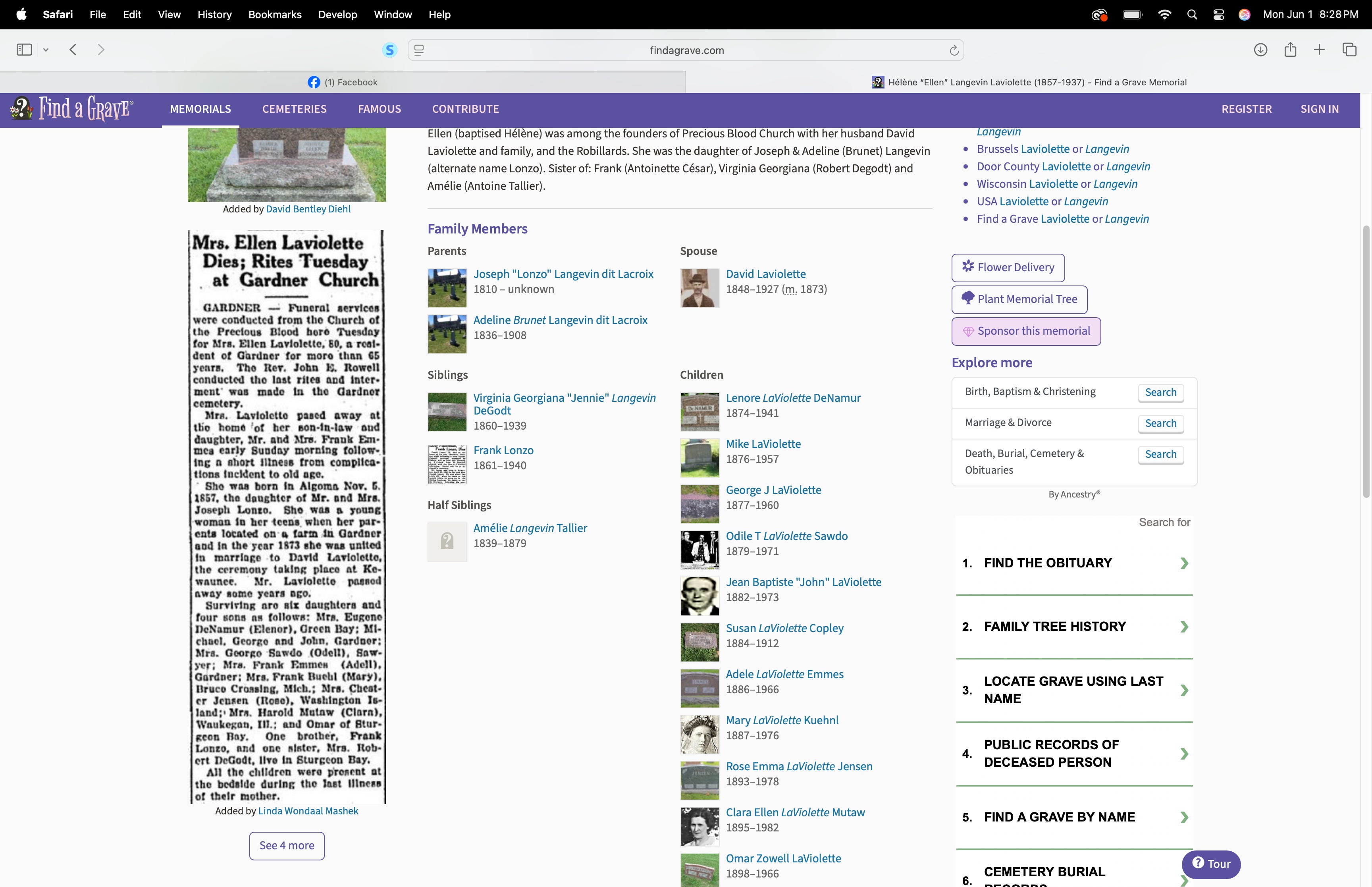
She outlived at least one of them. Susan died in 1912, not yet thirty. A mother of eleven in that era did not get to assume her children would bury her; the order of things was never guaranteed.
Ellen Laviolette died early on a Sunday morning in the spring of 1937, at eighty years old, after a short final illness. She passed in the home of her daughter Adell and son-in-law Frank Emmes — not in a hospital, not alone, but in a family house in the town where she’d spent more than sixty-five years. The local paper called her simply an early resident. The funeral filled Precious Blood again. Three women sang the mass. She was laid in the Gardner cemetery, beside the life she’d built.
And every one of her surviving children — all ten of them — was there at her bedside when she went.
I find I can’t say much more about her than this, and that’s the ache of it. We don’t have her voice. No letters surface, no diary, no recorded opinion on a single thing. What survives is a gravestone, two short obituaries that don’t quite agree on the details, and a list of names — her parents’, her husband’s, her children’s. The scaffolding of a life, with the life itself just out of reach.
But maybe that’s exactly why she’s worth writing about. Ellen Langevin Laviolette did the most ordinary and most impossible thing a person can do: she showed up, every day, for eighty years, in a place she helped make worth showing up for. Hélène became Ellen, the farm girl became a matriarch, and the church she founded outlasted her and is still standing.
That’s not nothing. That’s nearly everything.