Farmer, Shipfitter, Father
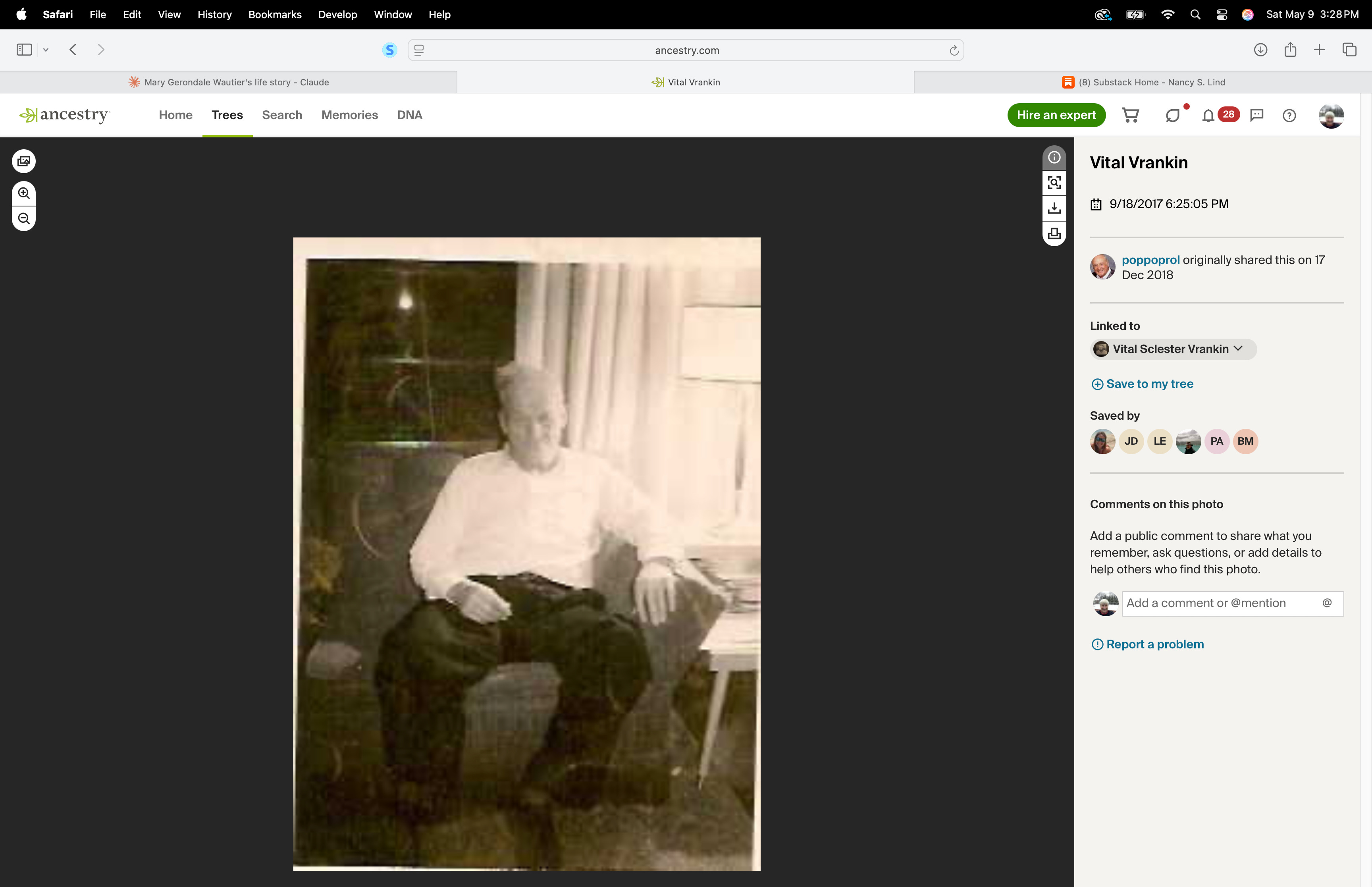
Vital Sclester Vrankin (27 July 1892/1893 – 7 June 1974) Gardner and Sturgeon Bay, Door County, Wisconsin

In a surviving family photograph, a group of men stand before a log cabin in Gardner, Wisconsin, identified as the Vranken Home Farm, across from the Bluff. Their names are written beneath the image: Vital Vrankin is on the far left— a household of sons. In the corner portraits, an older man and woman look out from oval frames, labeled as Friedland Latoure Vrankin and Oliver Vrankin.1
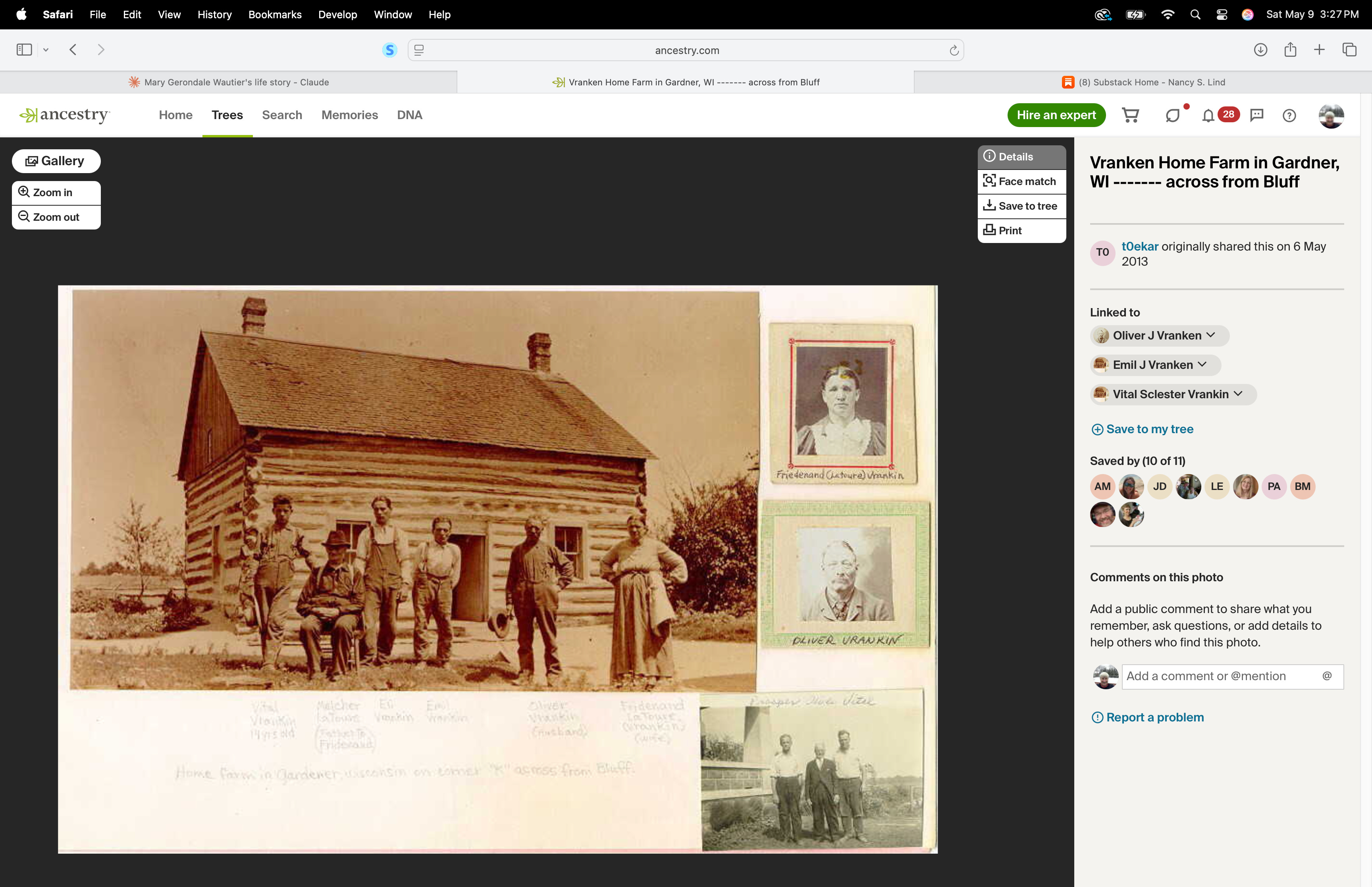
This is where Vital Sclester Vrankin began. From that log cabin in Gardner, Door County, he would live eighty-one years: through two world wars, the Great Depression, the death of his first wife, the building of warships, a second marriage, nine grandchildren, and a long final illness that ended at the Algoma Memorial Hospital on June 7, 1974.
He was buried in Stevenson Pier Cemetery, Little Sturgeon, Door County — beside Hermanie Tallman, the woman who had been his wife.2
The Vranken Farm in Gardner
The Town of Gardner, in southern Door County, Wisconsin, was part of the same Belgian-settled corner of the state that had been established in the 1850s by Walloon immigrants from the provinces of Brabant, Namur, and Liège. The township itself was named for Freeland B. Gardner, who had established a steam mill and shipyard at Little Sturgeon in the 1850s and at one point employed four hundred men drawn from the surrounding Belgian communities. The families of Gardner — Belgian, Irish, Yankee — lived within a few miles of the log cabins and brick farmhouses of Brussels and Union.3
The Vranken family farm was one of these Gardner homesteads. The log cabin visible in the family photograph tells its own story: in an era when the Belgian settlers were rebuilding in brick after the Peshtigo Fire of 1871, a log cabin in Gardner meant an older structure, or a family that had come to the area slightly differently from the mainstream of the Belgian migration.4
Vital was born on July 27 in either 1892 or 1893. His World War I draft registration card, completed by him in June 1917, gives his birth year as 1892. His World War II draft registration card, completed in 1942, gives 1893, as does his published obituary. The discrepancy is typical of early twentieth-century recordkeeping in rural Wisconsin, where birth certificates were not consistently filed, and memory and official record sometimes differed by a year.5
The same discrepancy touches his birthplace. Both draft cards — primary documents completed by Vital himself under oath — give his place of birth as Gardner, Wisconsin. His obituary describes him as “a native of Brussels.” The most likely explanation is that the Vranken family was embedded in the Brussels-Gardner Belgian community and considered themselves part of Brussels culturally, even if the farm itself sat in Gardner township.6
A Name from the Belgian Catholic Tradition
The given name Vital is the French form of the Latin Vitalis, meaning “of life” or “belonging to life.” It derives from Saint Vitalis of Milan, a first-century Christian martyr venerated in the Catholic Church whose feast is observed on April 28.7 In the Walloon-speaking Catholic communities of Door County, naming children after saints was deeply conventional. The name Vital had already appeared in the Belgian community: Vital Brice was the five-year-old son of Lambert and Marie Catherine Brice, one of the founding Belgian immigrant families of Door County, who arrived from Belgium in 1855.8
The middle name Sclester is unusual and its origin is undocumented in accessible sources. It does not appear in saint calendars or standard naming databases. It may be a family name carried forward as a baptismal middle name — a practice common in Belgian Catholic families — or a name specific to the Vrankin family’s particular kin network. Vital himself signed his name with it on his World War II draft card. Beyond that, the record is silent.
Farmer and Father: Before the First War
On June 5, 1917, Vital Vrankin walked to the Gardner precinct registrar and filled out his World War I draft registration card. He was twenty-four or twenty-five years old. He gave his address as Route 2, Brussels, Wisconsin. His occupation was farmer. He was employed in Gardner, Door County.9
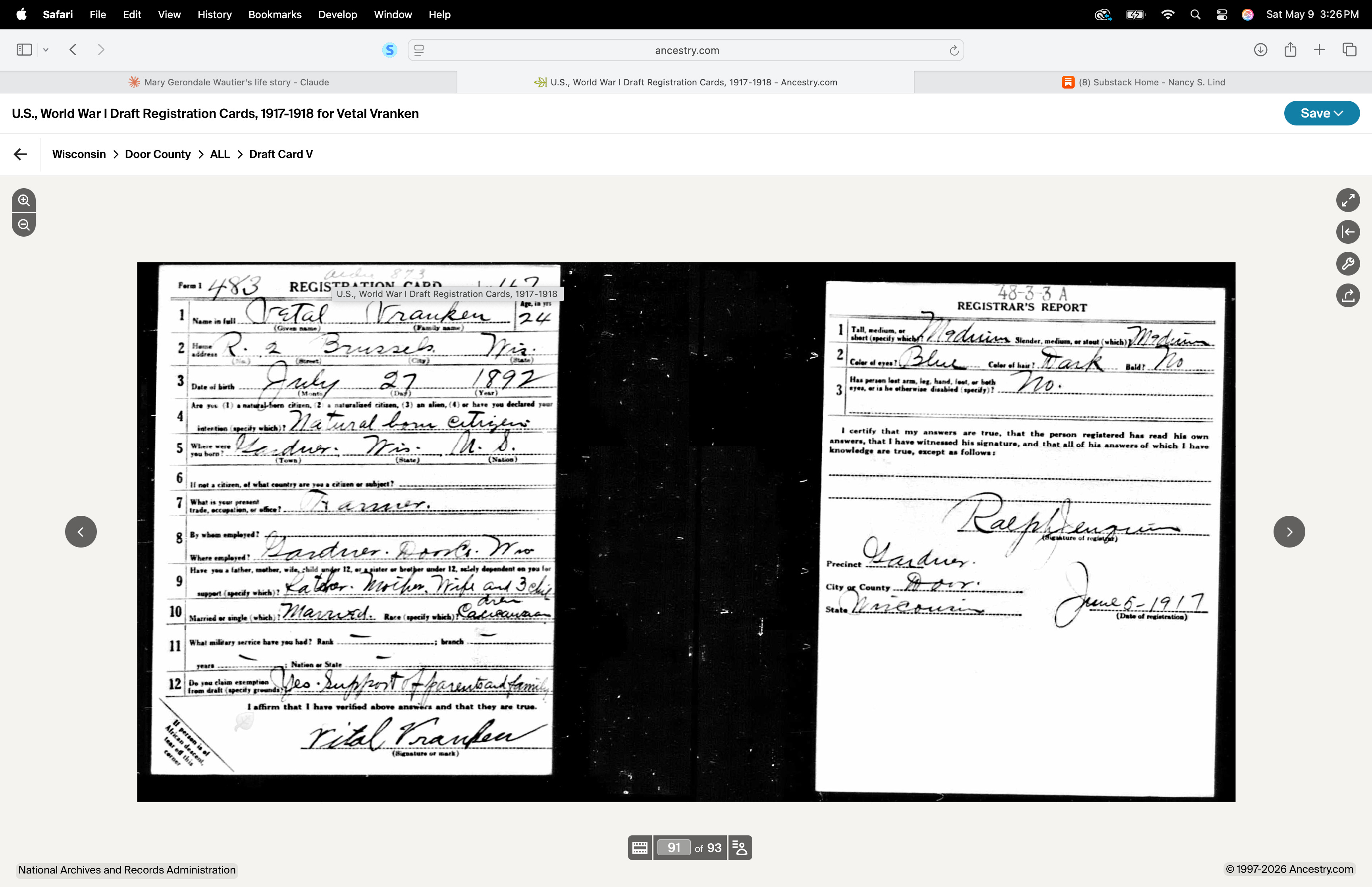
He was also already married, with children, and supporting his father and mother. The registrar described him in the physical notes as medium height, medium to stout build, with blue eyes and dark hair.10
His wife was Hermanie Tallman. She had been born in November 1889 in Wisconsin, the daughter of a family bearing the English-origin surname Tallman that had been present in the Gardner community for at least a generation. When Hermanie married Vital Vrankin, she took the Vrankin name — the same rare surname that Vital had been born with, an Americanized form of the Dutch Van Vranken, meaning “from the Frankish land.”11
The children they had together are named, at least in part, in his obituary: daughters Verona and Louella, and sons Floyd and Howard. Together they worked the farm in Gardner, in the shadow of the log cabin where Vital had grown up among his brothers.
Vital claimed exemption from the World War I draft on the grounds of his dependents — father, mother, wife, and children. He was not called to serve.12
From Farm to Shipyard
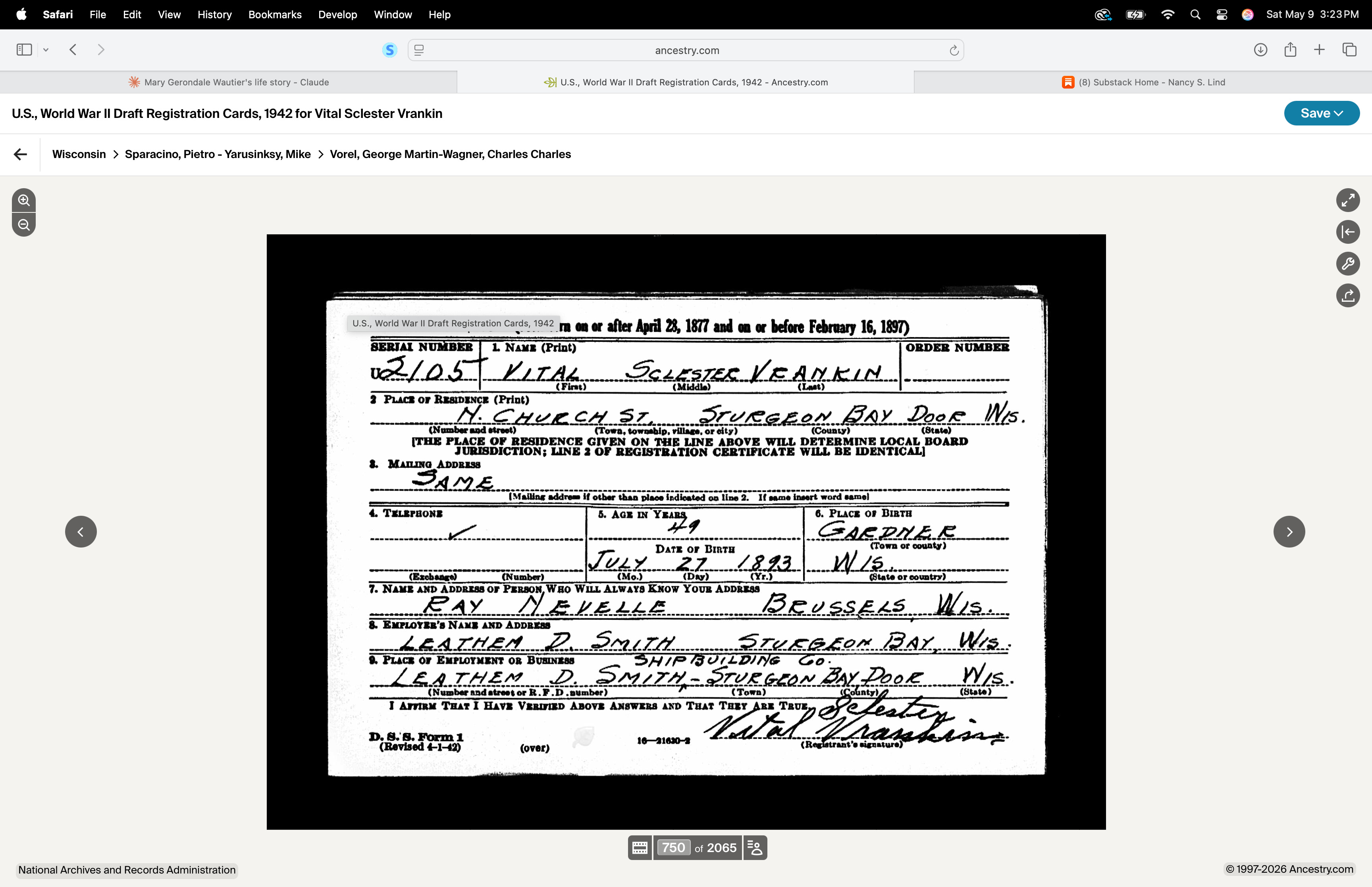
By the time Vital filled out his World War II draft registration card in 1942, his life had changed substantially. He was no longer a farmer in Gardner. He was living at N. Church Street, Sturgeon Bay, Door County, Wisconsin. His employer was the Leathem D. Smith Shipbuilding Company.14
The Leathem D. Smith Shipbuilding Company was one of the central industrial forces in wartime Sturgeon Bay. Founded originally in 1881 by John Leathem and Thomas Smith as a towing and wrecking concern, it had been restructured by Leathem’s son Leathem D. Smith in 1920 into a shipbuilding operation. By the time the United States entered World War II, Smith’s yard was receiving federal contracts to build warships for the United States Navy.15
The scale of what happened in Sturgeon Bay during the Second World War was staggering by any measure. The four shipyards of the city together produced 258 new ships for the war effort. Leathem D. Smith alone produced 93 vessels — frigates, net tenders, tankers, cargo vessels, and gunboats, including 38 submarine chasers 173 feet long. The yard peaked at approximately 5,000 workers and averaged a ship delivered every twenty days.16 In less than five years, total employment at all four Sturgeon Bay yards grew from a handful to over 7,000 workers, transforming the small city into a wartime boom town. The city bus service was set up specifically to shuttle workers between home and the yards.17
Vital Sclester Vrankin was one of those workers. He was a shipfitter — a trade that involved cutting, shaping, and joining the steel components of a ship’s hull and structure. A shipfitter works from blueprints, positions metal plates and frames, and ensures that the bones of a vessel are correctly aligned before the welders make them permanent. It is skilled, physical, precise work, the kind of labor that in wartime meant the difference between a ship that held together under fire and one that did not.
The obituary notes that he worked at “the former Christy shipyard” until his retirement. Leathem D. Smith Shipbuilding became the Christy Corporation in 1947, the year after Leathem Smith himself drowned in a yachting accident on Green Bay on June 23, 1946. Former general superintendent C. R. Christianson reorganized the yard under the Christy name, and Vital continued working there into his retirement years.18
Second Marriage and Later Life
In 1946 — the same year Leathem Smith drowned and the yard changed names — Vital Sclester Vrankin married again. His second wife was Elizabeth DeGodt Skippon, a widow with children of her own.19
DeGodt is a surname from the Flemish and Walloon Belgian tradition, from the Dutch de Godt, meaning “the good.” That Elizabeth DeGodt should find her way to Vital Vrankin in the shipyard city of Sturgeon Bay speaks to the enduring density of Belgian-descended families throughout the communities of northeastern Wisconsin, where names like DeGodt, Englebert, Dachelet, Counard, and Vrankin had been present for nearly a century.
Between them, Vital and Elizabeth had a combined family of children, stepchildren, grandchildren, and great-grandchildren. His obituary lists: daughters Verona (Mrs. Wilfred Maedke) of Manitowoc and Louella (Mrs. Warren Gaulke) of Green Bay; sons Floyd of Hammond, Indiana, and Howard of Milwaukee; nine grandchildren; six great-grandchildren; one surviving brother, Eli, of Sturgeon Bay; three stepdaughters and three stepsons.20
By the end of his life, Vital’s address was 725 Pennsylvania Street. He had moved from the log cabin farm in Gardner to a city street in Sturgeon Bay, carrying the Vrankin name — one of the rarest in the United States — through nearly eight decades of Door County life.
The Last Train and the Last Years
The Ahnapee and Western Railway had arrived in Brussels the month after Vital’s birth. It ended passenger service in 1937. The last freight train left Door County on September 4, 1969, when Vital was seventy-six or seventy-seven years old.21
He outlived the railroad he had been born beside. He outlived Hermanie by forty-eight years. He outlived his employer, Leathem Smith, who drowned in 1946. He outlived the wartime shipyard at its peak, and lived to see it become Christy Corporation, and then Bay Shipbuilding.
He died on Friday, June 7, 1974, at Algoma Memorial Hospital, after a long illness. He was eighty-one years old. Services were held Monday afternoon at the Davis Mortuary, with the Reverend David Harsh officiating.22
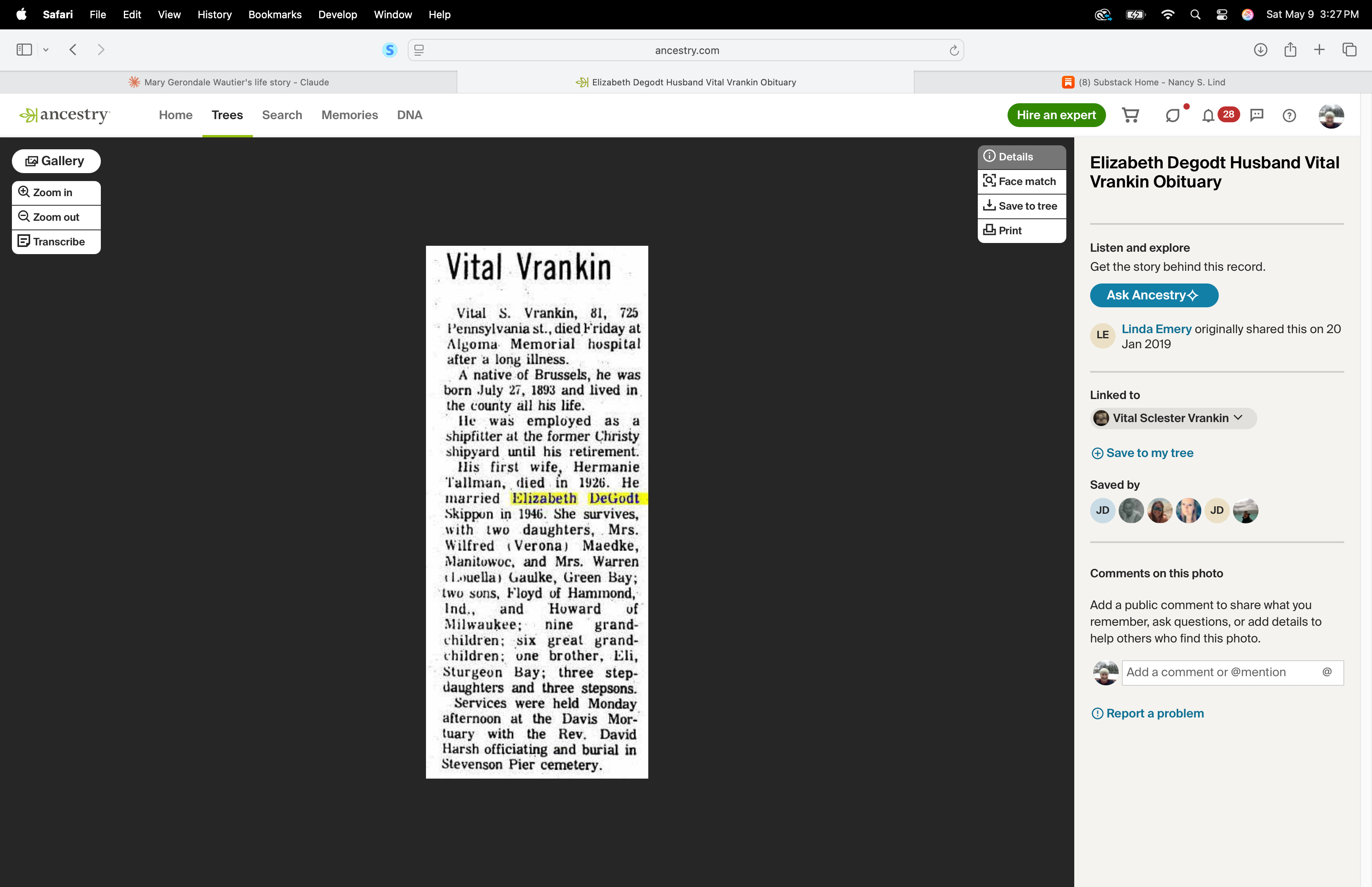
He was buried in Stevenson Pier Cemetery in Little Sturgeon — the oldest cemetery in that part of Door County, on the land that the founding Claflin and Stevenson families had set aside before the Belgians arrived in southern Door County, before the railroad whistle, before the shipyards, before any of it.
Hermanie was already there, waiting.
A Note on Sources
The obituary gives his birth year as 1893 and birthplace as Brussels; his WWI draft card gives 1892 and Gardner. Both sets of discrepancies are noted and explained in the text. All other facts are drawn from the primary documents listed in the endnotes. Nothing has been invented.
Endnotes
1. Family photograph, “Vranken Home Farm in Gardner, WI -------- across from Bluff,” Ancestry.com Trees, shared by user t0ekar, May 6, 2013. Oval portraits labeled “Friederand (Latoure) Vrankin” and “Oliver Urankin” (possibly an alternate spelling or the same Oliver). Linked to Oliver J Vranken, Emil J Vranken, and Vital Sclester Vrankin.
2. Obituary of Vital S. Vrankin, published newspaper clipping, Ancestry.com Trees, shared by Linda Emery, January 20, 2019 (title: “Elizabeth Degodt Husband Vital Vrankin Obituary”): “His first wife, Hermanie Tallman, died in 1926... burial in Stevenson Pier cemetery.” Find A Grave Memorial ID 90914762 confirms burial at Stevenson Cemetery, Little Sturgeon, Door County, Wisconsin.
3. Town of Gardner, townofgardnerwi.gov: “Freeland B. Gardner (1850), steam mill (saw & flour) and shipyard. He was the main employment for Brussels people having a total of 400 employees at one point.” Hjalmar Holand, History of Door County, Wisconsin, The County Beautiful, Chapter XLIV, genealogytrails.com: “In the west, occupying all of Gardner, Union and three-fourths of Brussels, live the Belgians.”
4. Wisconsin Historical Society, “Belgians in Wisconsin,” wisconsinhistory.org: “More common are 1880s red brick houses, distinguished by modest size and gable-end, bull’s-eye windows.” The family photograph clearly shows a log cabin rather than brick construction.
5. U.S., World War I Draft Registration Cards, 1917-1918, Vetal Vranken, Door County, Wisconsin, registered June 5, 1917 (Ancestry.com). Date of birth given as July 27, 1892. U.S., World War II Draft Registration Cards, 1942, Vital Sclester Vrankin, Serial No. U2105, Wisconsin (Ancestry.com). Date of birth given as July 27, 1893. Obituary of Vital S. Vrankin, op. cit.: “born July 27, 1893.”
6. WWI Draft Registration Card, op. cit.: “Born: Gardner, Wis., U.S.” WWII Draft Registration Card, op. cit., field 6 “Place of Birth”: Gardner, Wis. Obituary, op. cit.: “A native of Brussels.” Find A Grave Memorial ID 90914762: birth listed as Brussels, Door County, Wisconsin.
7. Nameberry.com, “Vitalis”: “The name Vitalis is a boy’s name of French origin meaning ‘of life, vital.’ Borne by a number of early saints, it comes from the Latin word for life.” Catholic Encyclopedia, “St. Vitalis,” newadvent.org: feast day April 28.
8. Peninsula Belgian American Club, belgianamerican.org: “Lambert Brice and his wife, Marie Catherine, left Belgium on June 9, 1855, with their four children, Esperance, 27; Adele, 24; Isabel, 20, and Vital, 5.”
9. U.S., World War I Draft Registration Cards, 1917-1918, Vetal Vranken, op. cit.: address R. 2, Brussels, Wis.; occupation: Farmer; employed: Gardner, Door, Wis.; registration date: June 5, 1917; precinct: Gardner, Door County, State: Wisconsin.
10. Ibid. Field 9 (dependents): “Father, Mother, Wife and 3 ch[ildren].” Field 10 (married or single): “Married.” Registrar’s Report: height “Medium,” build “Medium” (stout noted separately), eyes “Blue,” hair “Dark.”
11. Find A Grave Memorial for Hermanie Tallman Vrankin: Birth November 1889, Wisconsin. Obituary of Vital S. Vrankin, op. cit.: “His first wife, Hermanie Tallman.” The surname Vrankin as an Americanized form of Dutch Van Vranken: Ancestry.com, “Vrankin Surname Meaning.” Crests & Arms, “Van Vranken Family Crest,” crestsandarms.com.
12. WWI Draft Registration Card, op. cit., Field 12: “Yes. Support of parents and family.”
13. Obituary of Vital S. Vrankin, op. cit.: “His first wife, Hermanie Tallman, died in 1926.” Note: Find A Grave Memorial for Hermanie Tallman Vrankin gives death year as 1927; the obituary (a primary document) gives 1926.
14. WWII Draft Registration Card, op. cit.: Residence: N. Church St., Sturgeon Bay, Door, Wis. Employer: Leathem D. Smith Shipbuilding Co. Place of Employment: Leathem D. Smith, Sturgeon Bay, Door, Wis.
15. Door County Pulse, “A Half-Century of Building Ships at Fincantieri Bay Shipbuilding,” doorcountypulse.com: “The Christy Corporation began business in 1881. The corporation was a collaboration between John Leathem and Thomas Smith, which they called the Leathem & Smith Towing & Wrecking Company. In 1920, Smith’s son, Leathem Smith, took over the operation and restructured the business to include ship repair, renaming it the Leathem D. Smith Dry Dock Company.”
16. Wisconsin Labor History, “L.D. Smith Shipbuilding (Sturgeon Bay, Wisconsin),” wisconsinlaborhistory.org: “L.D. Smith Shipbuilding produced ninety-three frigates, net tenders, tankers, cargo vessels, and gun boats, including thirty-eight submarine chasers one-hundred-seventy-three-feet-long (known as ‘PC’s’).” Bay Shipbuilding Company, Wikipedia: “The yard peaked at about 5,000 workers during the war. During the war, Leathem averaged a ship delivered every 20 days.”
17. Wisconsin Labor History, “World War 2,” op. cit.: “In less than five years, the total employment at these four Sturgeon Bay shipyards grew from less than a handful to over 7,000 workers... Two government housing projects provided living quarters for six hundred families and five hundred individual workers, as well as a city bus service was set up to shuttle employees between work and home.”
18. Door County Pulse, “A Half-Century of Building Ships,” op. cit.: “Leathem Smith drowned in a yachting accident on Green Bay on June 23, 1946, and the next year, former general superintendent C.R. Christianson organized a new entity called the Christy Corporation.” Obituary of Vital S. Vrankin, op. cit.: “employed as a shipfitter at the former Christy shipyard until his retirement.”
19. Obituary of Vital S. Vrankin, op. cit.: “He married Elizabeth DeGodt Skippon in 1946. She survives.”
20. Ibid.: “two daughters, Mrs. Wilfred (Verona) Maedke, Manitowoc, and Mrs. Warren (Louella) Gaulke, Green Bay; two sons, Floyd of Hammond, Ind., and Howard of Milwaukee; nine grandchildren; six great-grandchildren; one brother, Eli, Sturgeon Bay; three stepdaughters and three stepsons.”
21. Door County Pulse, “The Rise and Fall of the Ahnapee & Western Railway”: “The Great Depression... brought an end to passenger service in 1937.” Abandoned Rails: “The last train to run in Door County departed Sturgeon Bay on September 4, 1969.”
22. Obituary of Vital S. Vrankin, op. cit.: “Vital S. Vrankin, 81, 725 Pennsylvania st., died Friday at Algoma Memorial hospital after a long illness... Services were held Monday afternoon at the Davis Mortuary with the Rev. David Harsh officiating and burial in Stevenson Pier cemetery.”